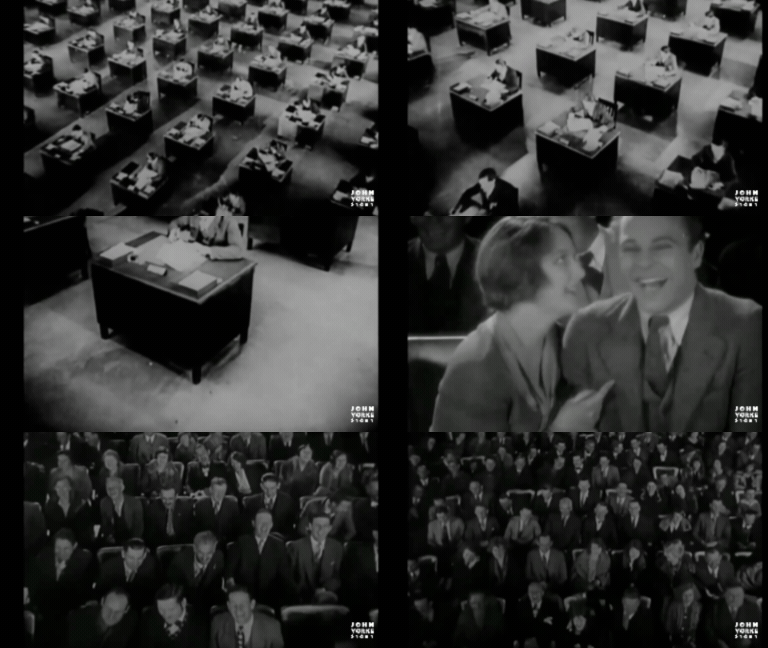
King Vidor’s 1928 silent epic The Crowd opens with a technically brilliant zoom into a Kafkaesque workspace. A million office drones surround our hero, the lonely, isolated John Sims. Ninety-eight minutes later the camera starts tight on John, having survived all that life can throw at him, including the loss of a daughter and attempted suicide. But now he laughs uproariously – and as the camera pulls back, we find him at a vaudeville show accompanied by his wife Mary, and surrounded by what seems like a million happy, smiling people.
It’s one of the very first filmic examples of a classic bookend – opening and closing images that, in echoing each other, are designed to encapsulate the huge nature of a protagonist’s change. Look closely at the film, however, and you notice it’s not just the opening and closing scenes that have such a unique relationship, but every other scene too.
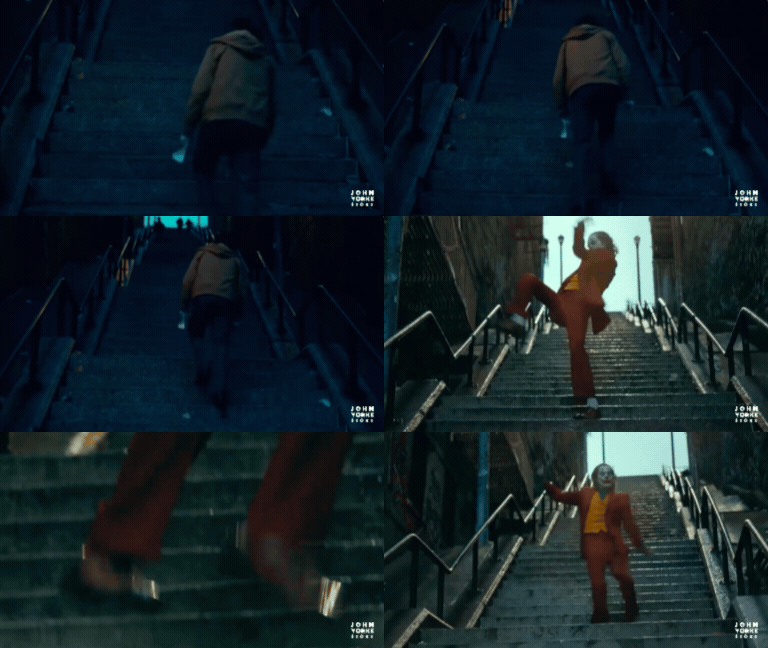
We see the same design principle in Todd Phillip’s Joker, almost a century later. Look where a bedraggled Arthur Fleck (Joaquin Phoenix) trudges his way laboriously up the iconic stairs in Gotham City, and then, once he’s discovered his new persona as the Joker, how he dances back down them again.
Indeed, look at the placing of ALL the stair sequences in the film. As he ascends and descends these symbols of heaven and hell, note how symmetrically they are placed – internal bookends, mirror images. There’s another word for this – Chiasmus.
What is it?
‘Ask not what your country can do for you,’ said President Kennedy. ‘Ask what you can do for your country.’ That’s chiasmus, a rhetorical device used more prosaically by Ronald Reagan: ‘Government does not get the money it needs; government always finds a need for the money it gets.’
It’s a phrase with a turn in the middle, making the second half an echo or mirror image of the first. Remember, of course, that a mirror image isn’t identical; it’s a reversal of the original shape.
In dramatic terms its power comes from inversion. ‘Look at that thing you think you know,’ the structure seems to say, ‘now see how much it has changed.’
Remember, of course, that a mirror image isn’t identical; it’s a reversal of the original shape.
– John Yorke
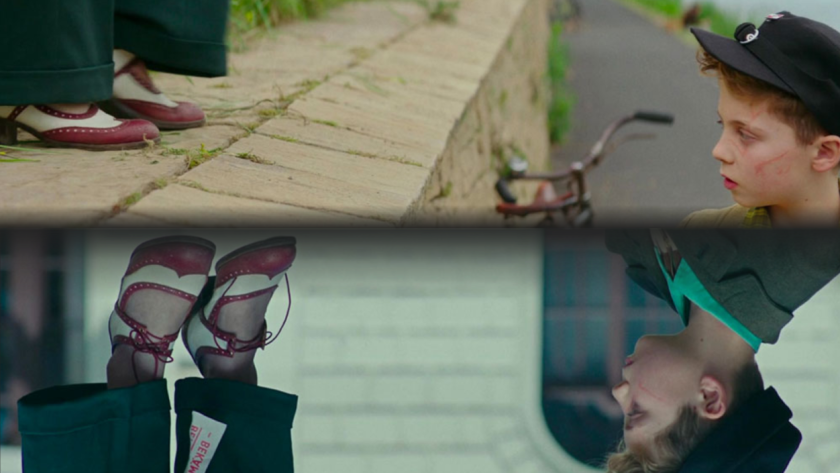
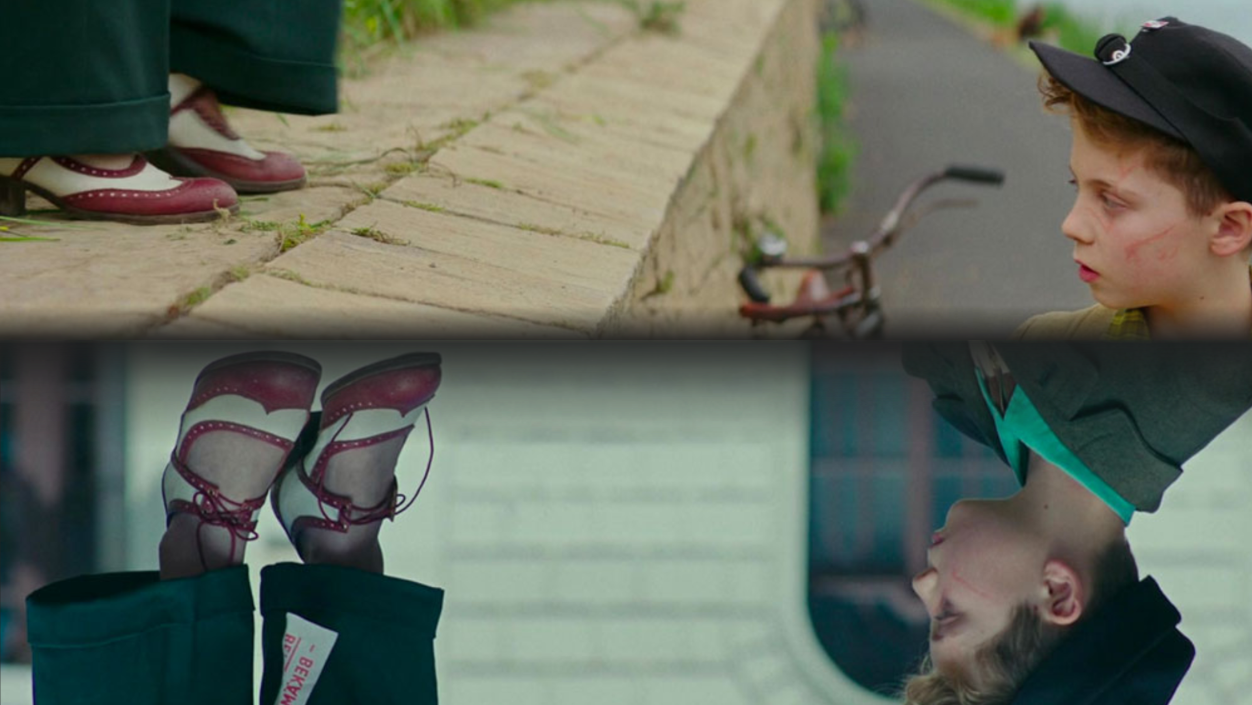
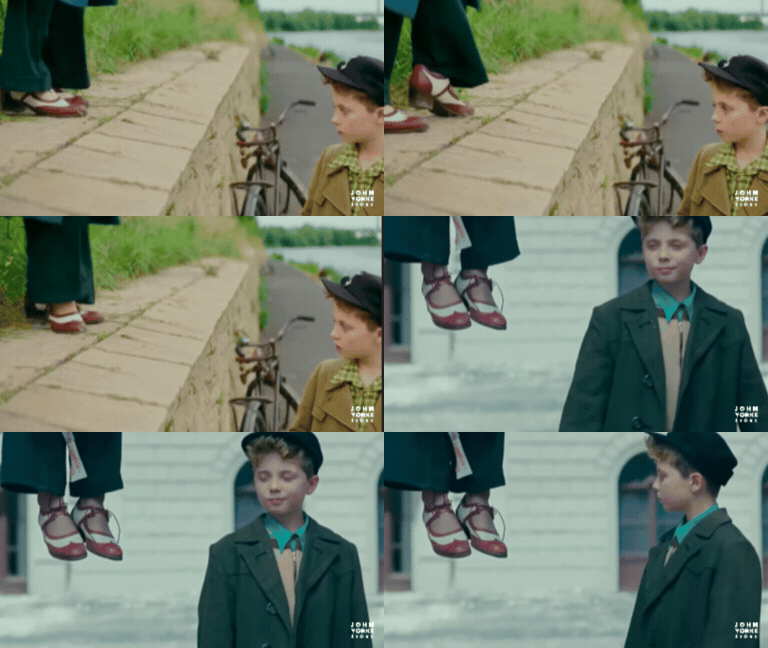
Jojo Rabbit is a film built very consciously around chiastic images – the shoes Jojo’s mum wears for dancing in the first half of the story later identify her when she’s found hanging from the scaffold in the town square. But it’s not just bookends or individual sequences. It is classic narratives as a whole. The way it is built around balance and change, means it’s far more deeply ingrained in the narratives we consume and even write than we are consciously aware.
Terminator 2 begins and ends with a voice-over from its heroine, Sarah Connor, the first ominous, the last hopeful. This is far from the film’s only parallel. The two great action sequences – one with fire, one with ice (in the form of liquid nitrogen) directly parallel each other, as do breaking out of a mental institution and breaking into the Cyberdyne HQ.
In the first half of the film, Sarah shouts at John for coming to save her and he cries, an action mirrored when Sarah later tells him she loves him and breaks down in his arms. The Terminator stitches up Sarah’s shoulder wound in the first half of the movie; fold the film over on itself, and she’s shooting Miles in the shoulder at the exact mirror position in the second half. In fact, the whole film has a chiastic structure.
You’ll see the same thing in Robocop and Aliens, but it is not just the preserve of commercial cinema. It’s equally true of the classic Edwardian novel E.M. Forster’s A Room with a View. Place a mirror in the middle of both book and film and you’ll not just find the passion of Florence opposing the repression of Metroland – you’ll find a whole series of absolute direct inversions. The more you look the more you start to see it as a governing principal – you’ll find it in works as diverse as the Koran, in the book of Genesis, in Tristram Shandy – in Russell T Davis’s It’s A Sin too.
Chiasmus, the use of opposites and symmetry simply happens too often in too many works from too many cultures to be a conscious construct or a mere coincidence. Instead it provides a valuable insight into how both the human mind and story structure work.
In Into The Woods we explored the classic nature of story structure through the prism of five acts – articulating a paradigm that underlines classic narrative shape:
- Set Up and Call To Action from antagonist
- Things go well through conflict – initial objective achieved
- Fortunes reach their apex
- Things start to go wrong precipitating crisis
- Final battle with antagonist – matters resolved for good or ill
So in Macbeth you will find this:
- The modest soldier hears the Witches’ prophecy.
- Angst ridden, and pushed by Lady M, he kills Duncan.
- He murders Banquo. Fleance escapes, Macduff defects.
- Murders Lady Macduff and her children, abandoned by all. Lady M commits suicide. Believes himself invincible, “cannot be killed.”
- Killed.
And two hundred years later, The Godfather has a very similar version:
- The law-abiding soldier hears his father has been shot.
- Saves his father in hospital, learns he’s not scared.
- Kills the men who attempted to murder his father.
- Gangs plot to kill him. Father dies.
- Kills everyone.
Look closely – the paradigm is symmetrical – classic story structure IS symmetrical – and at the heart of the story lies the meaning of the tale.
Macbeth embraces murder, so does Michael Corleone. It’s just not just single films. In the Harry Potter saga, in Star Wars, what do you find halfway through their epic episodic tales? Voldemort erupts into life, Anakin becomes Darth Vader.
Chiasmus, the use of opposites and symmetry simply happens too often in too many works from too many cultures to be a conscious construct or a mere coincidence.
– John Yorke
Just as we make sense of the world by seeing and interpreting the world around us, so story structure orders that process – we explore, we find the heart of the matter, and receive its chiastic echo.
Look finally at The Gruffalo – one of the best-selling children’s books of all time – and the platonic ideal of story structure. The mouse wants a nut, he takes a journey into the deep dark wood, halfway through he encounters the truth that lies at the heart of the forest – the Gruffalo itself. In the second half he must tame that monster by reversing his steps and making it safely home. Every archetypal story is about taming the monster – the “truth” that you find at the centre of the tale. Symmetry allows the accentuation and exaggeration of that process. It amplifies.
Chiasmus began as a rhetorical device to enhance meaning and memorability while answering the deep yearning desire for order – for there is no more powerful way of structuring your story. Chiasmus is the ultimate illustration not just of the ordering brain, but the desire for that order to be disseminated. Whether consciously or not (take a look at your own work – you may well find it there already) the more symmetrical the story, the more bewitching the story will be.
This article was adapted from Chapter 2: ‘The Meaning in the Middle’ of Trip to the Moon: Understanding the True Power of Story (2026). It serves as an overview/broad-strokes summary of the deep exploration John goes into on these topics of the midpoint, chiasmus and symmetry in narratives. Available at Amazon and Waterstones.